
Dare County Court Records After Arrest
After a Dare County jail arrest, there are two records tracks. The jail track begins with arrest, booking, custody status, bond, and release or transfer information at the Dare County Detention Center. The court track begins when the criminal charge is filed and the Clerk of Court retains the case. The Dare County Criminal Division says it keeps felony, misdemeanor, and traffic-infraction criminal records for the county.
The prosecutor's role sits between those tracks. Prosecutorial District 1, led by District Attorney Jeff Cruden, handles state criminal prosecutions for Dare and nearby counties. Booking charges may be the same as the filed court charges, but they can also be amended, reduced, dismissed, or supplemented after review. For the roster and custody side, use Dare County jail inmate records. For booking photos, use Dare County jail mugshots.
The court path is usually arrest, booking, magistrate or release conditions, charging decision, Clerk case file, court date, and disposition. A disposition is the case result, such as dismissal, plea, conviction, or other final court action. Until that happens, a charge is an allegation, not a conviction.
Find Dare County Court Records After Arrest
The North Carolina Judicial Branch Dare County page links to Portal Search/Pay and court-date tools. The public case-search portal is NC eCourts Smart Search. Use the location filter for Dare County when searching by name, record number, file date, case type, or case status. The portal may require CAPTCHA or session steps before results display.
- Open NC eCourts Smart Search and enter a record number or a name in last, first format.
- Use Advanced Filtering Options to select Dare County as the location when possible.
- Review criminal case entries and court dates tied to the same person.
- Compare charge status and bond orders with custody information from the jail or NC SAVAN.
- Contact the Dare County Clerk of Court if the record is terminal-only, confidential, older, or unclear.
The Clerk's local pages say public files are generally available for inspection except juvenile, adoption, and certain confidential records. They also state that criminal records are accessible on public computer systems, while court-related criminal and civil disputes should go to the Clerk rather than the county public-information office.
Dare County Court Search Fields
The eCourts Smart Search field set is broader than a jail lookup. That helps when a person has a common name, a known case number, a known booking number, or a narrow filing period. It also means a jail arrest may not appear until the court-side filing exists.
| Field Label | Type | Required | Notes |
|---|---|---|---|
| Record Number or Name | Text | At least one search criterion | Use record number or name in Last, First Middle Suffix format. |
| Last Name / First Name | Text | Required in party-name mode | Wildcard searches require minimum characters and an asterisk. |
| Filter by Location | Dropdown / multi-select | No | Select Dare County to narrow statewide results. |
| Case Type / Case Status | Dropdown | No | Use to separate active, closed, and case-category results where available. |
| File Date Start / End | Date | No | Helpful when the arrest date is known. |
| Booking Number, SO Number, FBI Number | Text | No | Useful if the jail or law-enforcement number is known. |
Dare County Charging Documents
A charging document is the paper or electronic filing that turns an allegation into a court case. North Carolina procedure can involve different charging paths depending on offense, stage, and court. The precise document in a Dare County case should be checked in eCourts or at the Clerk's office, but the basic distinction is still useful.
| Document | Plain Meaning | Why It Matters |
|---|---|---|
| Complaint or warrant-based filing | Initial allegation tied to arrest, warrant, or officer statement. | Often explains the first court charge after booking. |
| Information | Prosecutor-filed charge document in cases where that route applies. | Can show amended or formally selected charges. |
| Indictment | Grand-jury accusation for felony prosecution. | May replace, add to, or formalize earlier charge allegations. |
Dare County Charge Status
Charge status changes are why court records after a jail arrest should be checked directly. A sheriff release or jail booking may list one charge set on the day of arrest. The court file can later show new charges, dismissed counts, changed bond, reduced offenses, or a final disposition. That is normal and should not be read as an error without checking the record source and date.
| Status | What It Means |
|---|---|
| Pending | The charge is active and has not reached a final court result. |
| Amended or reduced | The prosecutor or court changed the charge from the original allegation. |
| Dismissed | The charge did not proceed to conviction. |
| Convicted | A guilty plea or finding resolved the charge against the defendant. |
| Disposition entered | The court has recorded a result, which may be a conviction, dismissal, or other outcome. |
Dare County Bond After Arrest
Bond and release conditions are set through the magistrate and court process, not by a web roster. Dare County's detention FAQ lists cash bond paid in full to the magistrate, a bail bondsman option, and North Carolina real property through the Clerk of Court. It says a bail bondsman may charge up to 15 percent of the bond amount under North Carolina statute. The magistrate office is at the Detention Center and can be reached at 252-475-9228.
| Bond or Release Type | Dare County Meaning |
|---|---|
| Cash bond | Full amount paid to the magistrate if no other hold blocks release. |
| Surety bond | Bail bondsman posts surety for a fee, if the bond type allows it. |
| Property bond | North Carolina real property may be pledged after Clerk contact. |
| Unsecured bond | No up-front payment, but the amount can be owed if conditions are violated. |
| No-bond hold | The person remains in custody until the court or holding agency changes status. |
Dare County Warrants and Arrest Records
No official standing Dare County active-warrant database was located in the research. The sheriff does publish selected warrant-related releases, and the court page warns that failure to appear can lead to monetary penalties, an order for arrest, or license consequences. That link between court and jail matters: a missed court date may create an order for arrest, which can lead to a new booking at the Detention Center.
For a possible warrant, use the correct office for the context. General routing can begin with the Sheriff's Office or non-emergency communications. A custody question belongs with the Detention Center. A court-related order for arrest belongs with the Clerk or eCourts. Bond questions after a warrant arrest belong with the magistrate.
Charges vs Convictions
A charge is an accusation. A conviction is a final guilty finding or plea. Court records after a Dare County jail arrest can show both, but they do not mean the same thing. Public search results should be read with the case status and disposition date in mind.
| Charge | Conviction | |
|---|---|---|
| Stage | Filed after arrest or by prosecutor action. | Entered after plea, trial, or final guilty finding. |
| Meaning | Alleged offense. | Final criminal responsibility for that count. |
| Can change? | Yes, it may be amended, reduced, or dismissed. | Changes usually require court action, appeal, or post-judgment relief. |
Sealed vs Expunged Dare Records
The Dare County Criminal/Traffic page says expunction petitions are filed with the Clerk's Office. It also cautions that not all charges are eligible, options depend on charge, disposition, and defendant age, fees vary, and the Clerk cannot tell a person which form to use or how to fill it out. Legal advice must come from an attorney.
| Sealed | Expunged | |
|---|---|---|
| Public access | Restricted from ordinary public view. | Removed through an approved court process when eligible. |
| Where to start | Clerk or court order. | Dare County Clerk expunction petition process. |
| Eligibility | Depends on record type and court order. | Depends on North Carolina law, charge, result, and age factors. |
Dare County Court Contacts
The North Carolina Judicial Branch Dare County contact directory lists local court contacts, including the Clerk, District Attorney, magistrates, judges, and related offices.
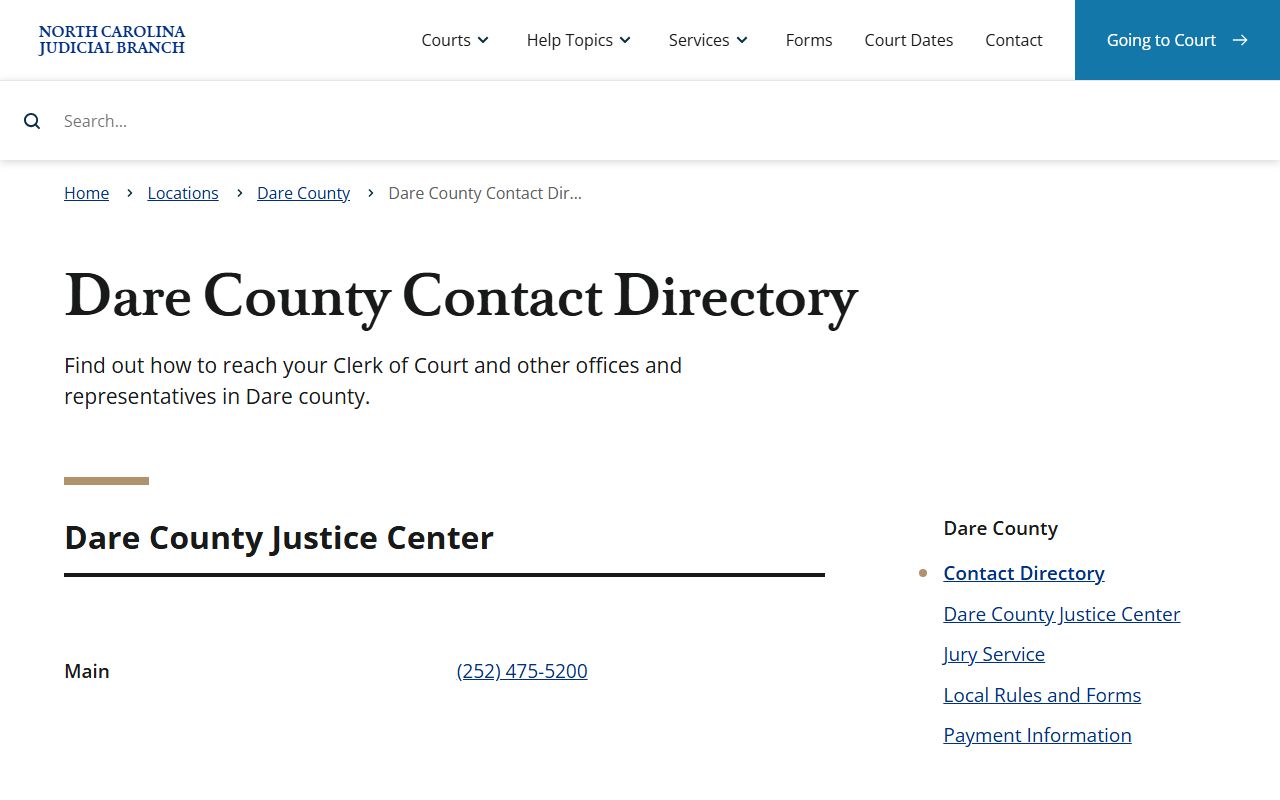
Use the court directory when the eCourts result does not answer a question about hearings, filings, or the correct court office for a criminal case.
Restricted Court Records After Arrest
Not every court record is public in the same way. Dare County's Clerk overview notes exceptions for juvenile files, adoption records, and certain confidential records. Active investigations, sealed matters, expunction orders, and records controlled by other agencies may also limit what can be viewed online. The county public-records process routes court-related criminal and civil disputes to the Clerk, which keeps those records separate from general county public-information requests.
Important: Case lookups are not consumer reports and should not be used for FCRA-covered decisions.